Last Wednesday I attended GitHub Universe on the Road here in Toronto. It was a great event, held at the Design Exchange, a beautiful venue and site of the original Toronto Stock Exchange.
The event began as many do. Big statements about the future and innovation. A recap of major features across GitHub’s platform and related applications, announced during GitHub Universe itself in SF a couple of weeks back. And big metrics: numbers of new and daily active users, commits, PRs, etc. The message was clear: GitHub had seen tremendous growth since the dawn of agents a year ago. It was now building tools to help meet the moment.
From agent to agent factory
What is that moment? It’s a good question. A year ago, the moment was engineers using agents to write code locally. Creating and building new primitives: skills, MCPs, plugins, etc. Creating the harness around the harness, but at a local level, so a human developer could get better outcomes with the agent on their laptop.
Today’s moment is much different. Agents and related workflows are moving into the cloud and the software development lifecycle itself, through tools like GitHub Agentic Workflows and Copilot automations. Increasingly, the job of engineering includes creating factories for agentic development. We’ve gone from the dev with an agent to the dev with an agent factory. And as more of the SDLC becomes automated, the role of the software engineer as we knew it is changing.
Beyond authorship
This shift was bluntly expressed in a slide displayed during the keynote: “We automated authorship. We didn’t focus on what it means to build software.” Underneath was a chart with a row for each part of building software. The green squares beside code stretched almost across the screen. Beside understand, decide, design, review, test and ship, hardly any.
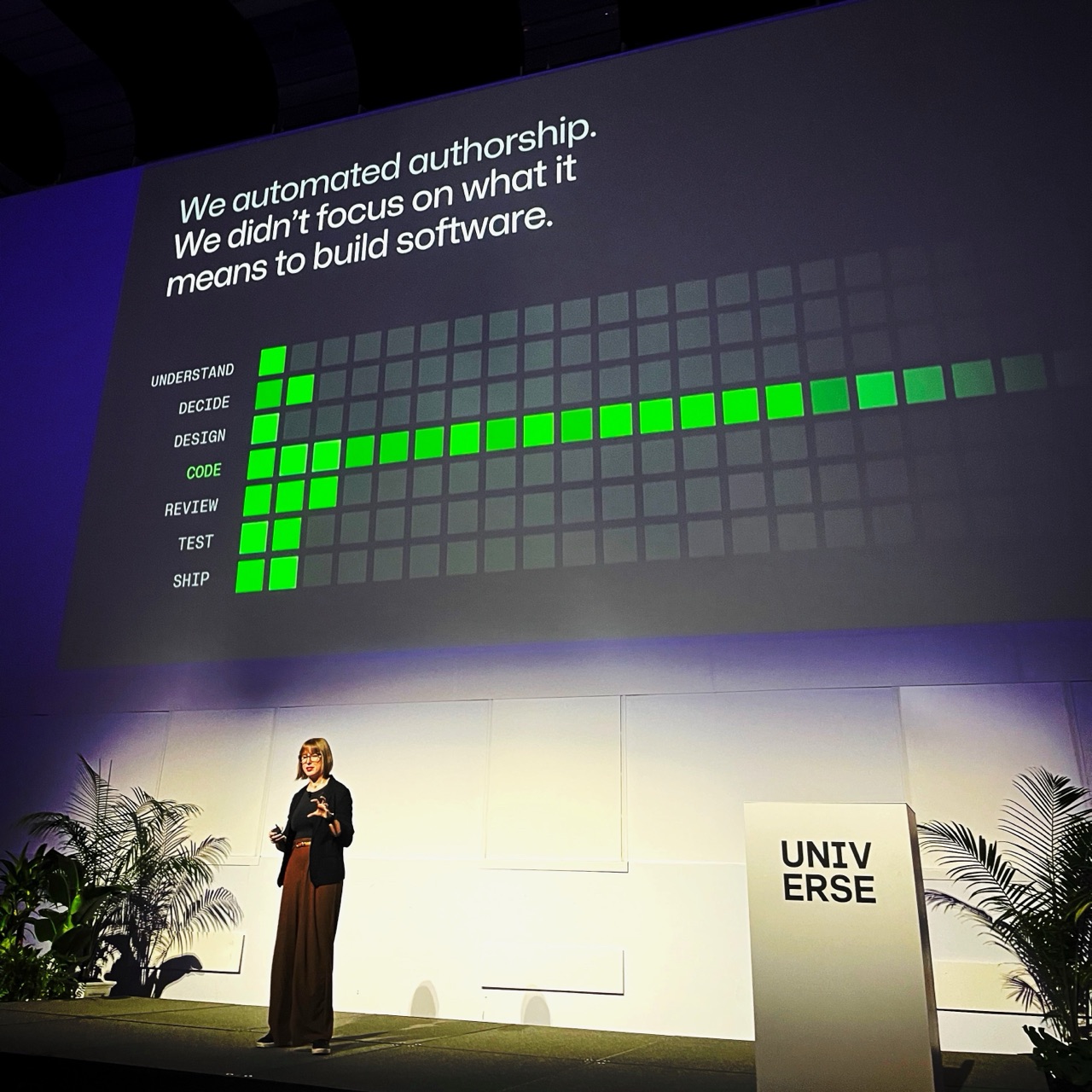
This slide stuck with me well after the event. It seemed to affirm the conclusion I came to in my thinking on the role of the product engineer. The need for T-shaped talent, for software professionals who can work across these other areas as agents handle more of the code, is growing. If you view your role and responsibilities as someone who waits for a fully defined ticket and then writes code to implement it, I’m sorry to tell you that not only has that never really been the job (it may have been, out of circumstance, for companies who could afford that kind of operating model, but it was not an optimal outcome), that role or idea of that role is under increasing pressure and not too distant obsolescence.
What businesses increasingly need from a software engineer is the ability to take an idea that a customer or product owner has and carry it through all of these stages. Automating what can be automated, and spending time with the customer or product owner to ensure the right things are being built, and built well enough to last and maintain. Which means the shape of a software development team is also changing.
Smaller teams, broader responsibilities
In my work lately with an engineering firm here in Toronto, this is precisely the conversation we’re having. The firm has an internal software development structure of 10–15 solution architects, 100 developers, two UX designers and another 10 QA. Looking at GitHub’s slide, I find it hard to see that balance of roles as the right shape for the work ahead.
At the level of an individual product, the team model we’re discussing is much smaller: one product manager, one product engineer (as I described in my previous article, and who at this firm might be a solution architect or a very senior developer), with fractional UX and QA support. QA would include manually testing and verifying outcomes that can’t reliably be tested through automation.
The shift is in the balance of the team: from one architect supporting ten developers to a smaller group with broader responsibility for the product.
One product team · fractional UX and QA
More of the code, review, testing and shipping can be handled by automated workflows. How far that can go will depend on the system and the work. But the direction is clear: smaller teams, with broader responsibilities, spending more of their attention on understanding the problem, deciding what to build and designing the solution. The people on those teams still need to be accountable for what ships and whether it lasts.
The people behind the transformation
If you’re not in this industry, it’s hard to fathom just how fast everything has been changing. But one thing that has struck me more than anything else is how little attention the human impact seems to receive alongside the technological change. Those of us who have worked in IT for a long time are living through a great transformation, and an even greater upheaval.
I left the event thinking about both the possibilities and the people. We’re building the tools to meet this moment. I’m less sure we’re preparing people for what it asks of them.